Sula Vineyards Ltd
A Stanford engineer quit Oracle, backpacked the world, and came home to plant grapes in Nashik. He ended up creating India's wine industry — and owning ~65% of it.
PUBLISHED 4 AUG 2026
- Ticker
- SULA
- Exchange
- NSE
- Sector
- Beverages / Wine
- Market Cap
- ~Rs 3,500 cr
THE BEGINNING
The Man Who Walked Away From Silicon Valley to Plant Grapes
By every conventional measure, Rajeev Samant had already won. He had a Stanford degree in Economics and Engineering Management, and a job at Oracle Corporation in Silicon Valley, where he was one of the company's youngest managers during the early-1990s tech boom. For an Indian engineer of his generation, this was the summit — the exact life that millions studied and emigrated for. And yet, somewhere inside that air-conditioned corporate success, Samant felt something hollow. The work was lucrative but, to him, meaningless.
So he did the thing almost nobody with that resume does: he quit. He spent roughly a year backpacking around the world, and then he came home — not to Mumbai's boardrooms, but to his family's modest 20-acre plot of land in Nashik, Maharashtra. There he began farming the unglamorous way, planting mangoes, roses, and teak. He was, by the standards of his Stanford classmates, throwing his career away to become a farmer.
What looked like a retreat was actually the start of one of modern India's most improbable category-creation stories. Because on that Nashik farm, Samant noticed something that would change Indian drinking habits forever: the soil, the elevation, and the climate around Nashik bore an uncanny resemblance to the world's great wine regions. In 1999, on land that had grown roses and mangoes, he would plant some of India's first modern commercial wine grapes — and name the venture Sula, after his mother, Sulabha.
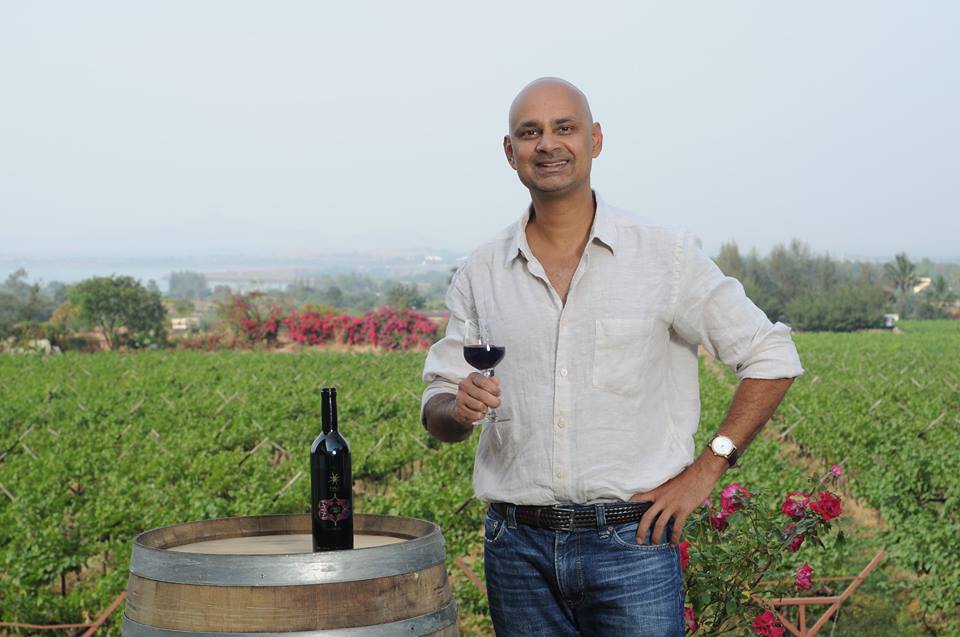
A Stanford graduate and former Oracle manager in Silicon Valley, Samant left a blue-chip tech career to return to his family's farm in Nashik. In 1999 he founded Sula Vineyards and effectively created India's modern wine industry from scratch — naming the company after his mother, Sulabha.
THE OBSCURE BET
A Realisation Borrowed From Napa Valley
The insight that started it all came in 1996. Standing on his Nashik farmland, Samant connected a dot that no one in India had commercially acted on: Nashik's latitude and weather shared key characteristics with Napa Valley and Bordeaux — the kind of warm days and cooler nights that wine grapes thrive on. In a country where wine was, at best, an exotic curiosity, this was less a business plan and more a leap of faith.
But Samant understood that a good hunch about terroir is worthless without genuine winemaking expertise. So he flew back to California, sought out veteran winemaker Kerry Damskey, and set about persuading him to do something extraordinary — relocate his craft to India, a country with virtually no wine tradition, no domestic market, and no template for how any of this would work. Convincing a seasoned American winemaker to bet on Nashik was its own act of salesmanship.
It worked. With Damskey's California expertise paired to Samant's local land and conviction, Sula Vineyards planted India's first modern commercial wine grapes in 1999. The country, at that moment, had effectively no wine culture to speak of. Sula was not entering a market; it was inventing one.
Roughly two of every three bottles of wine sold in India today come from a company a Stanford engineer started on a former rose-and-mango farm.
THE STRUGGLE
Selling Wine to a Country That Didn't Drink It
Creating a category from zero is romantic in hindsight and brutal in practice. Sula's first and biggest enemy was not a competitor — there were barely any — but indifference and unfamiliarity. Wine in late-1990s India was seen as foreign, elitist, and confusing. Most consumers had no frame of reference for it, no occasion to drink it, and no vocabulary to choose one bottle over another. Building a brand meant first building an entire habit.
Then came the regulatory maze. Maharashtra's liquor licensing regime, like much of India's, was complex, fragmented, and unforgiving for a young company trying to do something genuinely new. Every state was its own market with its own rules, taxes, and distribution constraints. Sula had to educate not just consumers but the entire chain — distributors who had never sold wine, restaurants that had never listed it, and retailers who didn't know where to shelve it.
Perhaps the most underappreciated battle was agricultural. Nashik's farmers had never grown wine grapes, which demand different vines, different timing, and different discipline from table grapes or other crops. Samant had to convince sceptical local growers to take the risk alongside him, effectively bootstrapping a supplier ecosystem at the same time as he was building a brand and a consumer base. He was constructing every link of the chain simultaneously.
"I left a job that paid me well to do something that, for years, almost no one in India understood. We weren't selling a product — we were creating a habit."
Rajeev Samant · Sula VineyardsTHE TURNING POINT
A Winemaker Moves East — and a Festival Changes Everything
Two moments turned Sula from a brave experiment into a category leader. The first was Kerry Damskey agreeing to relocate and become Sula's founding winemaker. That single decision imported decades of Californian winemaking craft into Nashik and gave Sula a quality foundation that would be very hard for later entrants to match. It is the difference between a farm that grows grapes and a winery that makes wine people actually want to drink again.
The second was a marketing masterstroke: SulaFest. By turning the vineyard itself into a destination — a music-and-wine festival and a weekend escape from Mumbai — Sula did something no advertising budget could. It normalised wine for a generation of young, urban Indians, reframing it from intimidating and elitist to aspirational and fun. Wine tourism didn't just sell bottles; it manufactured the cultural context in which buying those bottles made sense.
Together, these moves did more than grow a company. They built the road that India's entire wine market would later travel on — and Sula owned the road.
The Sula Journey — From a Nashik Farm to India's Wine Capital
THE MOAT
Why the Category Creator Usually Keeps the Category
Sula's most durable advantage is a subtle one: it didn't just win the Indian wine market, it built it. There is a particular economics to category creation. When a company manufactures an entire consumer category from nothing, the brand, the distribution network, and the consumer habit all form around the pioneer. To dislodge that pioneer, a challenger has to displace not only a product on a shelf but a memory in the customer's mind — the association of the category itself with one name.
For most Indians who drink wine, the gateway bottle was a Sula. That first-mover familiarity compounds. Restaurants default to listing it, retailers default to stocking it, and new drinkers default to trying it, because it is the name they already know. Decades of being the obvious choice create a flywheel that capital alone struggles to break.
Layered on top is the physical moat: vineyards take years to mature, winemaking expertise takes longer, and a deep multi-state distribution system for a licence-heavy product is painfully slow to replicate. Competitors such as Fratelli Wines, Grover Zampa, and York Winery are real, but all are significantly smaller. Sula essentially created and still dominates the market it pioneered.
How Sula Reaches the Indian Consumer
A brand built across bottles, hospitality, and tourism.
THE NUMBERS
What Market Leadership Actually Looks Like
The single number that defines Sula is its market share. The company commands roughly 65% of India's wine market — a level of dominance most consumer businesses can only dream of, and a direct dividend of having created the category in the first place. In a young, fast-growing market, that share is not a ceiling; it is a position from which to ride the entire industry's expansion.
Sula listed on the NSE and BSE in December 2022 as India's first pure-play listed winemaker, carrying a market capitalisation of roughly Rs 3,500 crore. In FY25 the company reported its highest-ever annual sales, underlining that the leadership built over two decades is still compounding. The business now spans not just bottles but a hospitality and wine-tourism arm centred on Nashik — turning the vineyard into a recurring brand experience.
India's Wine Market — Value Share
Approximate, based on industry estimates
WHY IT MATTERS NOW
The Tailwind Behind India's Wine Glass
Sula's story is timely because the category it created is finally hitting its stride. India's wine consumption has been growing at a rapid clip — estimated at more than 15% a year — off a base that was essentially zero when Samant started. As the category creator with the deepest brand and distribution, Sula is structurally positioned to capture a large slice of every incremental bottle the country drinks.
The deeper driver is premiumisation. A young, urbanising India is increasingly choosing wine as an aspirational, lifestyle beverage, and a growing cohort of younger consumers is opting for wine over spirits on certain occasions. The Nashik wine trail has, in parallel, become a genuine weekend-travel category for Mumbai and Pune — an experiential economy that feeds straight back into Sula's brand and tourism revenues.
The long arc is the most interesting part. If India's wine penetration ever approaches even a fraction of Western levels, the runway is enormous — and the company that taught the country to drink wine starts that race from the front. The risks are real: wine remains discretionary, weather and harvest cycles matter, and licensing is forever complex. But few consumer businesses get to grow a whole market and lead it at the same time.
Sula is a study in the quiet power of category creation. Rajeev Samant didn't find an existing market and compete for a slice of it; he saw a possibility no one else had acted on and spent decades building the demand, the supply, and the culture all at once. That is far harder and far slower than entering a proven market — but the reward is a kind of leadership that money struggles to buy, because the category itself becomes synonymous with your name. The deepest moats are not always patents or factories. Sometimes the moat is simply being the company that taught a country a new habit, and still being there when the habit becomes a market. The bravest bet is the one nobody else can see yet.
Financial figures are sourced from publicly available information and may not reflect the most recent reporting period. This is a story, not investment advice — please verify all data independently before making any financial decision.
Like this story? You can get the next one.
If they're your kind of thing, we'll deliver one a week. No pressure, unsubscribe anytime.
No spam, ever. Leave whenever you like.