Polycab India Ltd
His father died when he was 15. He dropped out of school to run a tiny hardware shop in Mumbai's Lohar Chawl. Today that shop is Polycab India — the country's largest wires and cables company.
PUBLISHED 4 JUL 2026
- Ticker
- POLYCAB
- Exchange
- NSE
- Sector
- Wires & Cables / Electricals
- Market Cap
- ~₹1,19,919 cr
THE BEGINNING
A Partition Refugee, a Hardware Shop, and a Boy Who Couldn't Walk Away
The story of India's largest wires and cables company does not begin in a boardroom or a business school. It begins with a man carrying almost nothing across a newly drawn border. In 1947, as Partition tore the subcontinent apart, Thakurdas Jaisinghani was one of millions of Sindhis who fled what had become Pakistan, arriving in a strange city with little more than the will to start again. He landed in Mumbai, and like many displaced traders before him, he chose the most honest path available: he opened a shop.
That shop appeared in 1964 in Lohar Chawl, the dense, clattering electrical market in the heart of old Bombay where every inch of pavement sells switches, bulbs, fans, and coils of wire. It was a small electrical-hardware counter, the kind a passer-by would never look at twice. There was no grand plan and no inheritance waiting in the wings. There was a family to feed and a counter to keep open six days a week. For a refugee household, survival itself was the business plan.
For a few years it worked the way such shops work — slim margins, long hours, regular customers, no headlines. And then, in 1968, the foundation cracked. Thakurdas died, leaving behind a wife, several sons, and a shop that could not run itself. The eldest boy capable of holding it together was Inder, who was just fifteen years old. What happened next would have been unremarkable in its sadness if not for what it eventually became.
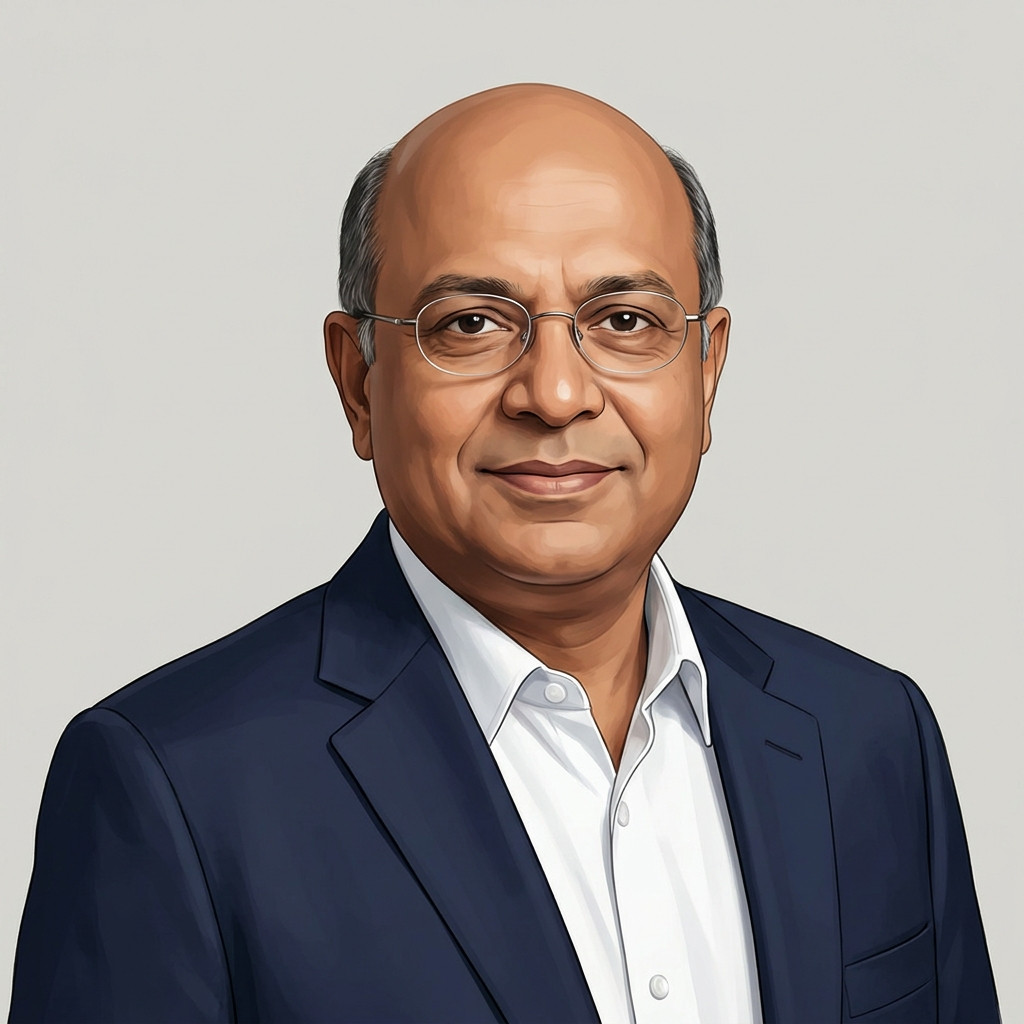
Dropped out of school at 15 in 1968 when his father died, to run the family's electrical hardware shop in Mumbai's Lohar Chawl. Over five decades he and his brothers turned that counter into India's largest wires and cables maker, listed in 2019 to a 51.77x subscribed IPO.
When Polycab finally listed in 2019, its IPO was subscribed nearly 52 times over — for a company most retail investors had never even heard of.
THE INHERITANCE NOBODY WANTS
Fifteen, Fatherless, and Standing Behind a Counter
Inder Jaisinghani did not inherit a company. He inherited a problem. At an age when most boys are worrying about exams, he left school for good and took his place behind the shop counter. There were no savings to fall back on, no formal education to lean on, and no influential backers to open doors. The shop's survival now rested on a teenager who had to learn the trade by selling it, one coil and one switch at a time.
The electrical-goods business he had been handed was brutally competitive even then. Lohar Chawl was crowded with traders who all bought the same products from the same manufacturers and competed mostly on price and credit. A trading shop is, by nature, a thin business: you buy a product, you mark it up a little, you sell it, and you hope volume makes up for the slim margin. There is no moat in being one of a hundred sellers of someone else's wire. For years, that was exactly the trap the family was in.
What set Inder apart was not a sudden stroke of genius but a refusal to accept that the shop was the ceiling. Working alongside his brothers, he came to understand the entire chain of the business he was in — who made the wire, what it cost, why quality varied, and where the real money sat. The men who controlled the business were not the ones selling wire in Lohar Chawl. They were the ones manufacturing it. That insight, formed slowly over the grind of the 1970s, would eventually reshape everything.
"We did not start with capital or contacts. We started with a counter, and we paid attention to everything that passed across it."
In the spirit of Inder Jaisinghani's journey · Polycab IndiaTHE OBSCURE BET
The Day a Trader Decided to Become a Maker
The pivotal decision was deceptively simple and quietly radical: stop only selling wire, and start making it. In 1975, the family acquired a plot of industrial land in the MIDC belt of Andheri in Mumbai and built their first cable manufacturing plant. For a household still anchored to a single shop, committing capital to a factory was an enormous, frightening leap. Manufacturing meant machines, working capital, technical know-how, and the patience to compete against established, better-funded players.
But the logic was unshakeable. As a trader you are a price-taker, squeezed from both sides. As a manufacturer you control your own cost, your own quality, and ultimately your own destiny. Over the next fifteen years, the family methodically migrated from the front of the value chain to the back of it — from the counter to the conveyor belt. The Polycab name, formally built up in the years that followed and incorporated as the business scaled in 1983, came to stand not for a shop but for a factory floor.
This was the contrarian move that defined the company. While many of their Lohar Chawl peers stayed comfortable as traders, the Jaisinghani brothers chose the harder, slower, capital-hungry path of building manufacturing capacity. It would take decades to pay off in full. But every plant they added compounded the advantage, until the gap between Polycab and a pure trader became unbridgeable.
The Polycab Journey — From a Lohar Chawl Counter to India's Largest Cable Maker
THE MOAT
Why Owning the Factory Changed Everything
Wire and cable looks, on the surface, like the dullest possible commodity — metres of copper and aluminium wrapped in insulation. And that is precisely why Polycab's strategy is so instructive. In a commodity, the only durable edge is to be the lowest-cost, most reliable producer at the largest scale. By owning manufacturing end to end rather than simply trading finished goods, Polycab built exactly that edge, and it strengthened with every passing year.
Vertical integration gave the company three things a trader can never have. First, cost control: when you make the product yourself, you capture the manufacturing margin instead of paying it to someone else. Second, quality control: in electrical wiring, where failure can mean fire, consistent quality becomes a brand in itself, and contractors and electricians learn to trust a name. Third, scale: today Polycab carries more than 10,600 SKUs, a catalogue breadth that only a large, integrated manufacturer can sustain and that smaller rivals struggle to match.
The result is a company that commands an estimated 26–27% share of India's organised domestic wires segment — roughly a quarter of an entire industry built from a single shop. That position did not come from marketing flash; it came from decades of compounding a boring, unglamorous advantage. The moat is the factory, the distribution, and the trust — none of which can be copied overnight, and all of which took fifty years to build.
Where Polycab Shows Up
From building sites to living rooms across 4,000+ towns
THE NUMBERS
What Five Decades of Patience Add Up To
Numbers tell the part of the story the family was too busy building to narrate. From a single counter, Polycab has grown into a business with revenue of roughly ₹22,600 crore in FY2026, anchored by its dominant wires and cables franchise and increasingly supported by its newer consumer-electrical lines. The figures below are illustrative and rounded, but the trajectory is unmistakable: a steady climb, accelerating sharply as India's construction and infrastructure cycle gathered pace.
Revenue Trajectory (₹ Crore)
FY21 to FY26 · illustrative, rounded figures
Revenue more than doubled across FY21–FY26, riding India's infrastructure and construction boomThe most striking proof point, though, is not the revenue line — it is the market's reaction the moment Polycab opened itself to public investors. In 2019, after decades of operating largely below the radar, the IPO was subscribed 51.77 times. Institutions and informed investors who had quietly tracked the company rushed in, even as ordinary retail investors were still learning the name. The family that started with a shop now sits on an estimated fortune of around 6.4 billion dollars — a measure not of luck, but of patience finally meeting recognition.
WHY IT MATTERS NOW
The Tailwind Behind Every Switch and Cable
Polycab's story is timely for a simple reason: almost nothing India is building today gets built without wire. The country is in the middle of a sustained infrastructure and construction push — new homes, highways, data centres, factories, metro lines, and a vast electrification and renewable-energy build-out. Every one of those projects runs on cables, and the organised, branded, quality-assured end of that market is exactly where Polycab is strongest.
The company is also no longer a one-product business. Its push into FMEG — fans, switches, lights and other consumer-electrical goods — aims to convert the trust it earned in wiring into a presence inside the Indian home, a far larger and higher-margin opportunity. With distribution already reaching more than 4,000 towns, Polycab is positioned to ride both the heavy infrastructure cycle and the slow, steady upgrade of the Indian household at the same time. It competes with serious names — Havells India, Finolex Cables, KEI Industries and Sterlite Technologies — but it does so from the position of scale leader, not challenger.
Look out five to ten years and the arc gets more interesting still. If India's capex cycle holds and electrification deepens, demand for wires and cables is structurally tilted upward, and the largest organised player tends to capture a disproportionate share of that growth. The same vertical integration that took fifty years to build now becomes a flywheel: more scale lowers cost, lower cost wins share, more share funds more capacity. The boy behind the counter built a machine that compounds.
Polycab is a reminder that the most powerful businesses are often built in the least glamorous corners of the economy, by people who had every reason to quit and chose not to. Inder Jaisinghani inherited grief and a thin trading shop at fifteen, and instead of accepting the ceiling that came with it, he and his brothers spent decades moving up the value chain — from selling wire to making it, from a counter to a factory, from anonymity to a 51.77x IPO. There was no single masterstroke, only a thousand patient decisions stacked on top of one another until they became unassailable. For a long-term investor, the takeaway is almost uncomfortable in its simplicity: durable advantage is usually boring, it almost always takes longer than you'd like, and it rewards the people who keep compounding quietly long after everyone else has lost interest. The shop that no one noticed became the company everyone wanted to own.
Financial figures are sourced from publicly available information and may not reflect the most recent reporting period. This is a story, not investment advice — please verify all data independently before making any financial decision.
Like this story? You can get the next one.
If they're your kind of thing, we'll deliver one a week. No pressure, unsubscribe anytime.
No spam, ever. Leave whenever you like.