Control Print Ltd
Every expiry date on every pack was stamped by a machine. In 1991, a chemical engineer from Nagpur started a Mumbai company to sell them, lost his biggest partner, and learned to build his own.
PUBLISHED 16 NOV 2026
- Ticker
- CONTROLPR
- Exchange
- NSE
- Sector
- Industrials
- Market Cap
- ₹942 crore
THE DATE ON THE PACK
Every Expiry Date Has an Author
Pick up a packet of biscuits, a strip of tablets or a bottle of oil, and look for the small print: a batch number, a manufacturing date, a "best before". Nobody designs that line and nobody admires it. It is stamped in a fraction of a second as the pack rushes past on a conveyor, by a machine most shoppers will never see and few could name.
That unglamorous line is the whole business of Control Print, a Mumbai company that began on 14 January 1991 and today has a market value of about ₹942 crore. It makes coding and marking machines, the printers that put the date on the pack, along with the inks and solvents that keep them running. Its FY26 revenue was about ₹480 crore, and in that year it sold 3,064 printers.
It is also an unlikely survivor. The market it chose was shared among global names such as Domino, Videojet and Markem-Imaje. A Mumbai company had no obvious right to a place on those production lines. It earned one by showing up, staying, and eventually learning to build the machine itself.
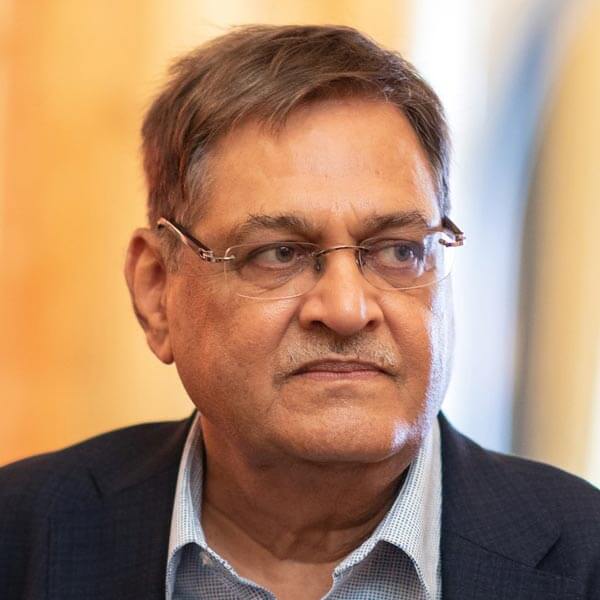
A silver merchant's son from Nagpur and a chemical engineer by training, Basant Kabra has led Control Print since 1991. His son Shiva, a Grinnell and INSEAD graduate, is Joint Managing Director and runs marketing, business development and strategy.
The founder is Basant Kabra, a silver merchant's son from Nagpur who trained as a chemical engineer. His first venture had nothing to do with printing. He started a polymer manufacturing company in Mumbai, with its plant in Baroda, and spent his early working years learning how a factory runs.
That venture ended in a split with his partner. He moved into coding and marking after seeing the technology at work abroad, and Control Print became one of the first in the industry with a local presence in India.
The business is built on chemistry as much as hardware: the machines print with inks and solvents that have to keep flowing. Kabra set up Control Print in Mumbai on 14 January 1991, with the plan of manufacturing the machines himself.
EIGHT CITIES, ONE PROMISE
The Years Nobody Wanted a Printer
The plan was to manufacture. The market had other ideas. Volumes in the early 1990s were too low to justify building machines, so Control Print changed course and became a marketer, distributor and service provider for a few well-known foreign manufacturers. Videojet was among them.
"The initial days were tough," Kabra says, and hiring was part of the trouble because the company was so small. A coding machine sits on a live production line, and when it stops, the line stops. Customers wanted proof that someone would answer the phone.
"We decided to list it in 1993, so that people have confidence in the company."
Basant Kabra · Control PrintSo the company did two expensive things early. It went public in 1993, two years after it began, to signal permanence. And it opened offices in about eight cities, so that a plant manager anywhere could be sure a service engineer was close by. For a company this young, it was a heavy fixed cost carried on faith.
The first breakthrough came in the late 1990s, when Pepsi set up a plant and wanted a large number of printers. At the time, most manufacturers in India were not buying coding printers at all. A bulk order from a global beverage name was a rare vote of confidence in a market that was not yet buying.
From there the business grew steadily. In the three years to March 2014, revenue grew at an average of 14% a year to ₹93.8 crore, with net profit of ₹14.1 crore. The next year, 2014/15, revenue reached ₹112.92 crore and net profit ₹19.15 crore.
By 2015 it was selling about 1,500 to 2,000 printers a year, priced from ₹75,000 to ₹3.5 lakh. The inks cost ₹6,000 to ₹10,000 a litre. The industry was worth roughly ₹550 to ₹600 crore and growing about 12% a year. In 2015 the estimated shares were Domino about 32%, Videojet 27 to 28%, Markem-Imaje about 22%, and Control Print 16 to 17%, with a goal of 25% within five years.
The price of a single litre of coding ink in 2015, against a ₹75,000 starting price for the printer that uses it.
Then came the moment that almost killed it. Around 2007, the Videojet partnership ended.
The company that had spent sixteen years selling a partner's machines now had to make its own.
NALAGARH, 2008
Learning to Build the Machine
In 2008, the company developed its first coding machines, using some core German technology but designed and built from the ground up for the unique conditions in India. That year it opened a 30,000 sq ft factory at Nalagarh in Himachal Pradesh. In 2015 it added a 65,000 sq ft factory at Guwahati in Assam.
By 2015 it worked with eight or nine technology partners and manufactured their products under licence. It had also localised 96% of printer parts, partly by developing components itself and partly by pushing suppliers to raise their quality. Making the machines in India was how it became cost competitive.
The company says it is the only coding and marking company manufacturing in India, and the only one with locally built equipment able to compete head-to-head with foreign technology. For a firm that once sold other people's machines, it is the reverse of where it began.
The Control Print Journey — From a Mumbai Start-Up to a Global Footprint
A LITRE OF INK AT ₹10,000
Why a Printer Is Hard to Replace
The moat starts with where the machine sits. A coding printer is bolted onto a live production line, and every pack that leaves the factory depends on it. Replacing one means stopping the line, retraining operators and proving the new machine works. Few plant managers volunteer for that.
Then there is the ink. Each machine needs a steady supply of consumables, and the company sells both: printers from ₹75,000 to ₹3.5 lakh and inks at ₹6,000 to ₹10,000 a litre. A machine installed once becomes a customer for as long as it runs.
The economics reward patience. In 2015 the whole Indian industry was worth roughly ₹550 to ₹600 crore a year, and Control Print held 16 to 17% of it while selling only 1,500 to 2,000 printers. The printers are the entry ticket; the inks and the service that follow are what keep a customer for years.
Service is the third layer. The offices opened in the 1990s to reassure worried customers gave it a service network early. And making its own machines in India, with 96% of printer parts localised by 2015, is how it stayed cost competitive.
₹482 CRORE AND A DIP IN PROFIT
The Numbers Since FY22
In the last five years, revenue has nearly doubled. Consolidated sales rose from ₹256 crore in FY22 to ₹482 crore in FY26. In FY26 alone, revenue grew 12.3% from about ₹431 crore the year before, to about ₹484 crore.
Consolidated Sales (₹ Crore)
FY22 to FY26 · ₹ crore
Sales up about 88% in four years, from ₹256 crore to ₹482 croreGrowth has come steadily rather than in a rush. Sales crossed ₹300 crore in FY23, ₹400 crore in FY25 and are now close to ₹500 crore. In FY26 the company sold 3,064 printers, against 1,500 to 2,000 a year in 2015.
Profit tells a bumpier story. Net profit was ₹53 crore in FY23 and ₹54 crore in FY24, then jumped to ₹100 crore in FY25, a year lifted by a one-time deferred tax gain. In FY26 it came back to ₹44 crore. The share price closed at ₹589 on 16 November, inside a 52-week range of ₹517 to ₹785.
Part of the pressure comes from the company's overseas push. The Italian packaging subsidiary, V-Shapes, is still loss-making, and management says the investment is key to moving from distribution to owning its own intellectual property. Higher wage costs from the new labour codes, and input and freight costs, add to the pressure.
FROM MASKS TO MARKPRINT
Beyond the Printer
The company has kept widening its reach. In April 2020, as COVID-19 closed factories, it launched The Mask Lab to make surgical masks and respirators. In July 2022 it bought 85% of Markprint BV in the Netherlands, and it also acquired V-Shapes of Bologna in Italy. It has invested in track-and-trace solutions as well, the systems that follow a pack from factory to shelf.
Each step reaches beyond the printer-and-ink business toward packaging and traceability. The bet is that a date on a pack is only the start of what a factory needs to show about its products.
Management describes the aim as a move from distribution toward owning its own intellectual property, the same instinct that pushed the company to build its own machines in 2008. The company that once resold a partner's printers now wants to own the technology.
The bet is not yet paid for. The Italian business is still losing money, and profit has fallen back from its peak. For now, the home business of printers and inks carries the group, and the story of the next few years is whether the overseas pieces can match it.
THE LINE NOBODY READS
What a Small Date Teaches
Basant Kabra did not pick a glamorous market. He picked a necessary one, so humble that the giants treated it as a service line. He started by selling other people's machines, and when the biggest partner walked away he learned to build his own. Early on he bought credibility with a public listing and offices in eight cities, and the late-1990s order from Pepsi showed it working. The inks keep the machines busy and the service keeps the customers loyal, but the real moat was refusing to be dependent. Somewhere near you right now, a date is being stamped on a pack by a machine that a Mumbai chemical engineer decided his country should learn to make.
Financial figures are sourced from publicly available information and may not reflect the most recent reporting period. This is a story, not investment advice — please verify all data independently before making any financial decision.
Like this story? You can get the next one.
If they're your kind of thing, we'll deliver one a week. No pressure, unsubscribe anytime.
No spam, ever. Leave whenever you like.