Biocon
In 1978 no bank would lend to a 25-year-old with ₹10,000 and a rented garage. Kiran Mazumdar-Shaw kept building anyway, from brewing enzymes to the first interchangeable biosimilar insulin in the US.
PUBLISHED 26 OCT 2026
- Ticker
- BIOCON
- Exchange
- NSE
- Sector
- Biopharmaceuticals
- Market Cap
- ₹53,584 Cr
THE GARAGE IN BANGALORE
A Rented House, a Garage and Ten Thousand Rupees
In November 1978, a telegram reached a young woman in Bangalore with the news she had waited weeks for: "Congratulations, your application has been approved." Kiran Mazumdar-Shaw was 25. She had spent nearly three weeks walking into Udyog Bhawan in Delhi every morning, and touts in the corridor had asked her for ₹10,000 to complete her project report. She had exactly that much, and she had set it aside to start her company. She refused to hand it over.
The money was the whole of her capital. Biocon India Private Limited was registered on 29 November 1978 as a joint venture with an Irish enzyme maker, Biocon Biochemicals, whose founder Les Auchincloss wanted a partner in India to supply him with papain. Her own training pointed the same way. She had studied malting and brewing in Melbourne, qualified as a master brewer in 1975, and come home to a country where brewing was not considered a woman's trade.
So she rented a house and turned its garage into her office. The first two hires were tractor mechanics close to retirement, Gangappa and Nasir Ahmed, who were taught to run the machines and turned out to be exactly the people who could keep them running. A school teacher and friend, Pratima Rao, took a sabbatical to handle the paperwork for the first year. Production began with papain, a plant enzyme, and isinglass, a marine extract, both key products for the brewing industry.
Within six months the first shipment of isinglass was ready to leave for export. In 1979 Biocon became the first Indian company to manufacture and export food-processing enzymes to the United States and Europe. The garage was still the head office. Nothing about it looked like the start of what would one day be called India's largest biopharma company.
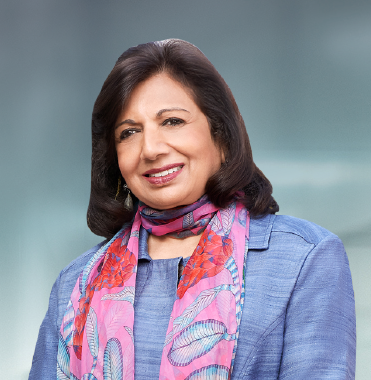
Born in Bangalore in 1953, she studied zoology before training as a master brewer in Melbourne. She started Biocon in 1978 at the age of 25 and has led it through its move from enzymes into biosimilar insulin and cancer drugs.
THE BANK DOOR THAT KEPT CLOSING
Every Bank Said Come Back With Collateral
The enzymes sold. The banks did not. She was 25, she had no assets to pledge, and the managers she met wanted a guarantor. They asked for her father. She told them it was her company and refused to bring him in. "Every time I would go to the bank, they would sort of shut the door on me."
"I was 25 year old and nobody took me seriously."
Kiran Mazumdar-Shaw · BioconThe break came at a wedding reception at the Ashoka Hotel, where she met Dinesh Nayak of Canara Bank and told him the whole history. He admired her nerve and kept his word with a credit line of ₹4 lakh. It was a small line, but a real one. In 1980 the company bought 20 acres on Hosur Road, and the foundation stone of its first building went in on 8 March that year.
The building took three years. Cement and steel were rationed in the run-up to the Asian Games, and that slowed the work. The new campus was inaugurated on 2 November 1983, and manufacturing moved out of the garage for good. The company had a factory, a research programme and a growing list of overseas customers, and its next idea was about to need far more money than a credit line.
That idea was a homegrown way of making enzymes through solid-state fermentation. Around 1990, the state financial corporation looked at a solid-state fermentation pilot plant that would cost ₹1 crore and decided it was too risky. It told her to licence imported technology instead. She refused.
The loan that would have built the future was turned down.
THE ₹1 CRORE PILOT PLANT
The Investor Who Bet on a Young Scientist
Narayanan Vaghul of ICICI had been a mentor since the two met at a USAID meeting. When the bank route failed, he helped arrange equity funding. She calls that meeting the inflexion point of her journey and says that if he "hadn't bet on me when I needed it the most, I wouldn't have scaled up." In 1991, Biocon's first commercial solid-state fermentation plant was commissioned.
The ownership around her was changing too. In 1989 Unilever's enzyme arm had acquired Biocon's Irish parent, and in 1995 Biocon and Unilever formed Biocon Quest India, with about half each. Syngene, a research-services company, had been founded in 1993, and in 1996 she moved the company into statins, using the same fermentation know-how. In 1998 Biocon became an independent, privately owned company again, with 80% of its business in enzymes and 20% in biopharmaceuticals.
The shift paid off in 2001, when Biocon became the first Indian company approved by the US FDA to make lovastatin. In 2004 it became the first company in the world to develop recombinant human insulin on a Pichia yeast expression system, and Insugen is still the largest generic insulin brand in India. That same March, the company went public. The issue ran from 11 to 18 March 2004 at a band of ₹270 to ₹315, drew bids for five times the shares on offer within an hour, and closed about 32 times oversubscribed, with more than 90% of demand at the top of the band.
On its first day of trading Biocon closed with a market value of US$1.11 billion. It was only the second Indian company to cross a billion dollars on its listing day, and the first biotech company to go public in India.
The 2004 IPO was subscribed about 32 times, with demand above ₹10,000 crore, for a company that began with ₹10,000.
THE YEAST THAT MAKES INSULIN
Why a Fermentation Company Is Hard to Copy
A biosimilar is a copy of a drug that is itself grown inside living cells, and no two cell lines behave the same way. The skill sits in the fermenters and in the people who have run them for decades. Biocon had been working with fermentation since its first enzymes in 1978, and its insulin was built on the same craft.
The company then did something unusual with its own past. In 2007 it sold its enzymes business, the one the garage had started, to Novozymes for US$115 million. The money funded a joint venture with a Cuban institute to build a mammalian-cell plant. In 2009 it partnered with Mylan on biosimilars of trastuzumab, bevacizumab, adalimumab, pegfilgrastim and etanercept.
The results came one after another. In 2013 India approved the first biosimilar trastuzumab anywhere in the world, and in 2014 Biocon launched it at the world's lowest price. In 2017 Ogivri became the first biosimilar from an Indian company approved by the US FDA, and in 2018 Fulphila became the first biosimilar from India commercialised in the United States. In July 2021, Semglee became the first interchangeable biosimilar insulin approved in the US, which lets a pharmacist substitute it for the original without going back to the doctor.
Biocon's Journey — From a Garage to a Global Biosimilar Maker
₹16,927 CRORE IN FY26
What the Garage Became, in Numbers
For the year to 31 March 2026, Biocon's revenue from operations was ₹16,927 crore, up 13% once a one-time generic lenalidomide sale in the previous year is set aside. EBITDA was ₹3,798 crore, a 22% margin and about 200 basis points better than the year before on a like-for-like basis. Net profit before exceptional items was ₹436 crore, and ₹386 crore after them.
Where FY26 Revenue Came From
FY26 · ₹ crore, segment revenue before inter-segment eliminations of ₹411 crore
The two ends of the story show how far it has travelled. The IPO priced at the top of its band, ₹315 a share, and closed its first day at a little over a billion dollars. The market capitalisation today is about ₹53,600 crore, with the shares trading near ₹329. Syngene, the research arm she started in 1993, listed in 2015 and crossed a billion dollars in market value within a week.
SEMGLEE AND THE VIATRIS DEAL
One Company Where There Used to Be Three
On 29 November 2022, Biocon Biologics completed the purchase of its partner Viatris's global biosimilars business, paying US$2 billion in cash and issuing preference shares worth US$1 billion. The deal gave it direct control of eight commercial products and a portfolio of 20 biosimilar assets. It also meant that revenue from the Mylan partnership, which had begun in 2009, now came straight to Biocon Biologics.
In December 2025 the company went one step further. It had weighed an IPO for Biocon Biologics and a merger with the parent, and chose to fold the subsidiary fully into Biocon Limited, valuing the biosimilars business at US$5.5 billion. Biocon bought out the minority investors by a share swap and paid Viatris US$815 million for its remaining stake, US$400 million of it in cash. The board approved raising up to ₹4,500 crore from investors, largely to pay the cash portion.
The integration was complete by the end of FY26, and on 1 April 2026 Shreehas Tambe took over as chief executive and managing director. Kiran Mazumdar-Shaw stays as Executive Chairperson. "We are now focused on profitability enhancement and long-term value creation," she said in May. A company that once could not find a bank now runs generics and biosimilars under one roof, alongside a listed research-services subsidiary.
WHAT THE GARAGE TAUGHT
Almost every big step in this story followed a refusal. The banks shut the door in 1978, and the state financial corporation turned down the ₹1 crore pilot plant in 1990. Each time the choice was between taking someone else's terms or technology and building her own, and each time she built her own. The pattern was not stubbornness for its own sake. She kept looking until she found the one backer who understood the science, and years later she had the nerve to sell the enzyme business that gave her a start so that a larger one could be built. The garage was only the first workshop. The same fermentation craft, in far bigger rooms, now serves more than 6.5 million patients a year.
Financial figures are sourced from publicly available information and may not reflect the most recent reporting period. This is a story, not investment advice — please verify all data independently before making any financial decision.
Like this story? You can get the next one.
If they're your kind of thing, we'll deliver one a week. No pressure, unsubscribe anytime.
No spam, ever. Leave whenever you like.