Azad Engineering Ltd
He failed Class 10 and dropped out of school. In 2008 he rented a 200 sq m shed in Hyderabad with one second-hand machine and decided to make parts for jet engines. Today Rolls-Royce trusts him.
PUBLISHED 9 SEPT 2026
- Ticker
- AZAD
- Exchange
- NSE
- Sector
- Aerospace & Precision Engineering
- Market Cap
- ~Rs 5,500 Cr
THE SHED IN BALANAGAR
A Second-Hand Machine, 200 Square Metres, and a Ridiculous Ambition
In 2008, in an industrial pocket of Balanagar in Hyderabad, a 28-year-old rented a shed of about 200 square metres and wheeled in a single second-hand CNC machine. There was no order book, no marquee client, and no engineering degree anywhere in the building. What there was, was a used machine and a man who had spent twelve years learning to listen to one. Rakesh Chopdar had decided that this shed would one day make the components that sit inside jet engines and gas turbines — the most punishing machining work on earth, where a mistake is measured in microns.
To understand how absurd that sounded in 2008, you have to understand what India’s private aerospace manufacturing looked like at the time: essentially nothing. There was no domestic supply chain to plug into, no local firm that had already walked the path and could show him the door, no cluster of certified precision suppliers feeding global engine makers. The customers he wanted — Rolls-Royce, GE, Pratt & Whitney — did not know India as a place they bought turbine aerofoils from. They knew it as a place they occasionally set up back-offices.
And Chopdar himself was, on paper, the least likely person in the room. He had failed his Class 10 board exams and left school. At 16 he began working in his father’s small machine shop, sweeping floors and, slowly, learning to run the machines. While his peers collected engineering degrees, he collected hours — twelve years of them — standing at a lathe, watching metal behave, teaching himself the intricacies of precision CNC machining with no syllabus and no professor. In 2008, he put those twelve years into a shed and bet everything on them.
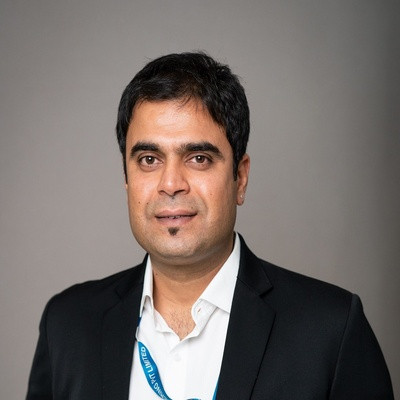
A first-generation, self-taught engineer from Hyderabad who failed his Class 10 exams and dropped out of school. He started on the shop floor of his father’s machine shop at 16 and spent twelve years teaching himself precision CNC machining. In 2008 he founded Azad Engineering with one second-hand machine; today the company supplies ultra-precision components to Rolls-Royce, GE Aviation, Pratt & Whitney, Honeywell and Siemens.
A jet engine turbine blade has to survive temperatures hotter than the melting point of the metal it is made from — kept alive only by internal cooling channels thinner than a human hair. That is the tolerance world Azad chose to enter, from a shed.
THE PAPERWORK NOBODY WANTED TO TALK ABOUT
The Real Barrier Was Never the Machine. It Was the Certificate.
People assume the hard part of aerospace manufacturing is the metal. It isn’t. Any well-funded workshop can buy a good machine. The hard part is convincing a company whose product carries 300 passengers at 35,000 feet that your shed in Hyderabad is allowed to touch a part inside its engine. That permission is called qualification, and it is brutal by design.
Azad had to earn certifications like AS9100D and NADCAP from a standing start — standards that Indian private industry had, at the time, essentially never attempted. There was no consultant down the road who had done it. There was no peer company to copy a process document from. Every audit, every traceability system, every metallurgical test protocol, every operator training record had to be built from first principles by a team led by a man who had never sat in an engineering classroom.
And here is the part that almost ended it: qualification takes years, and during those years you earn nothing. You are spending on machines, on inspection equipment, on skilled people, on audit after audit — while producing no revenue from the very customers you are courting. For a self-funded first-generation entrepreneur with no pedigree and no cushion, that is not a business plan. That is a slow-motion siege. Most people running out of runway would have taken the safe local job-work orders and quietly given up on jet engines.
THE EUROPEAN AEROFOIL
One Order Changed What Azad Was Allowed to Become
The break came from Europe. A firm placed an order with Azad to manufacture aerofoils for thermal power turbines — and Azad delivered them to the tolerance the customer demanded. On its own, it was one contract. In practice, it was a certificate of existence.
Because in this industry, credibility is the product. The moment a global buyer had validated that an Indian SME with no pedigree could hold aerospace-grade tolerance, the conversation with everyone else changed. Doors that had been theoretical became real. GE Aviation. Rolls-Royce. Pratt & Whitney. Honeywell. Siemens. Mitsubishi Heavy Industries. Baker Hughes. The names arrived not because Azad got cheaper, but because Azad got trusted.
In December 2023, Azad Engineering listed on the NSE. A company that started in a 200 sq m shed with one used machine is today valued at roughly ₹5,500 crore. Sachin Tendulkar — a man who knows something about precision under pressure — is an investor. The Class 10 dropout runs a listed company whose parts spin inside engines built by the most demanding manufacturers on the planet.
“I could not pass a Class 10 exam. So I spent twelve years passing a harder one — every single day, at the machine.”
The spirit of Rakesh Chopdar’s journey · Azad EngineeringTHE MOAT MADE OF AUDITS
Why a Rival With More Money Still Cannot Catch Up
Azad’s competitive advantage is one of the strangest and strongest in Indian manufacturing: the qualification IS the business. When a global OEM like GE or Rolls-Royce certifies a component supplier, the process runs for years and involves hundreds of audits — of the process, the metallurgy, the traceability, the people, the failure history. Nothing about it can be bought, rushed, or shortcut with capital.
This means a well-funded new entrant walking in tomorrow with better machines and a bigger balance sheet still cannot serve Azad’s customers tomorrow. They must serve time first. Meanwhile the incumbent supplier is not standing still — each additional part qualified, each additional programme won, deepens the switching cost. Once your component is designed into an engine platform, the OEM has every incentive to keep you there for the life of that platform, which in aerospace can run for decades.
It also explains why Azad keeps building dedicated facilities for individual customers — exclusive lean manufacturing lines for the likes of GE Vernova’s steam power services, Mitsubishi Heavy Industries and Baker Hughes. Each one is not just a factory. It is a relationship made physical, and a further reason for that customer never to leave.
From a Rented Shed to Rolls-Royce
Who Trusts Azad With Their Engines
Global OEMs across aviation, energy and defence.
THE NUMBERS BEHIND THE SHED
What an Impossible Bet Looks Like on a Balance Sheet
The clean way to see Azad is not through a revenue line but through the wall it climbed. Every metric below is really a measure of one thing: permission. Permission from the hardest customers in the world to touch the most critical part in their machine.
The Climb, In Plain Terms
Indicative view of what changed between 2008 and today
WHY IT MATTERS NOW
India Is Finally Being Allowed Into the Room
For decades, India bought aircraft and licensed engines. It did not make the parts inside them. That is changing on two fronts at once. Civil aviation in India is in the middle of a historic expansion, with airlines placing some of the largest aircraft orders in the world — and every one of those aircraft needs a supply chain to feed and maintain it. Simultaneously, the defence indigenisation push through DRDO and HAL is actively looking for domestic private partners capable of aerospace-grade work. Azad sits precisely at that intersection, and it did not get there by lobbying. It got there by qualifying.
The proof points are recent and concrete. In 2024, Rolls-Royce signed a partnership with Azad for defence aero-engine components. The company has inked long-term deals with Pratt & Whitney Canada for aircraft engine parts and with Mitsubishi Heavy Industries, and has built dedicated facilities for GE Vernova’s steam power services and Baker Hughes. These are not one-off purchase orders. They are platform-level commitments, the kind that get renewed for years because the cost of switching supplier is measured in re-qualification, not in price.
And then there is the number that frames the entire next decade: India’s aerospace exports are barely 1% of the global market. If even a small fraction of global engine-component work shifts toward Indian precision suppliers over the next ten years — and the certifications, the facilities and the OEM relationships now exist to allow it — then the companies already sitting inside those approved supply chains do not need to win new arguments. They simply need to be there when the volume arrives. Azad, uniquely among Indian private firms, already is.
Return to that second-hand CNC machine in the shed. It was not special. Anyone could have bought one. What could not be bought were the twelve years Rakesh Chopdar had already spent learning to use it — and the years he was then willing to spend earning certifications that paid nothing until they suddenly paid everything. This is the quiet truth of durable businesses: the moat is almost never the asset, it is the accumulated time nobody else was willing to spend. Markets reward what is scarce, and patience of that specific kind is the scarcest thing there is. A degree can be earned in four years; the trust of Rolls-Royce cannot. Chopdar failed the exam that was supposed to sort him out, and then chose a harder one that had no answer key, no deadline, and no guarantee — and took it every day for twenty-five years. The shed was never the constraint. The willingness to wait was the whole edge.
Financial figures are sourced from publicly available information and may not reflect the most recent reporting period. This is a story, not investment advice — please verify all data independently before making any financial decision.
Like this story? You can get the next one.
If they're your kind of thing, we'll deliver one a week. No pressure, unsubscribe anytime.
No spam, ever. Leave whenever you like.